ALI ZAMANI
Full Stack Developer — web apps, games, cross-platform software, AI solutions, and robotics.
RESUME
// cat resume.log --skills --experience
projects_startups.log
HomeHost
LearningCity
FreeGadget
farmhero
AiDiscovery
work_experience.log
Freelance Full Stack Developer
Senior Software Engineer
Full Stack Developer
education.log
Associate — Computer Software
B.Sc. Software Engineering
M.Sc. Software Engineering
LAST POSTS
// tail -n 3 ~/posts/

Why Is 5 GHz Wi-Fi Faster but Worse at Crossing Walls?
Your home router broadcasts two networks: 2.4 GHz and 5 GHz. One crawls through walls but is slow; the other is blazingly fast but suffocates one room away. This post shows what frequency actually does: why more bandwidth means more data per second; what happens when a wave meets a wall (transmission, reflection, absorption); why a concrete wall swallows up to 40 dB of power at 5 GHz; and how a 12 cm wavelength behaves differently from a 6 cm one around obstacles — with a Python simulation of a whole apartment's signal map and an interactive lab where you light the apartment up on both bands.

Why Does Every QR Code Have Three Squares in Its Corners?
Every QR code has three large squares in three corners and none in the fourth. This post shows what those three squares (the finder patterns) actually do: how a camera recovers a code's position, orientation and scale from a blurry, tilted photo; why exactly three — not two, not four; why their shape carries the 1:1:3:1:1 signature; and how Reed-Solomon error correction keeps a stained code readable — with Python scripts that build a code and find its squares, plus an interactive lab where you become the scanner.
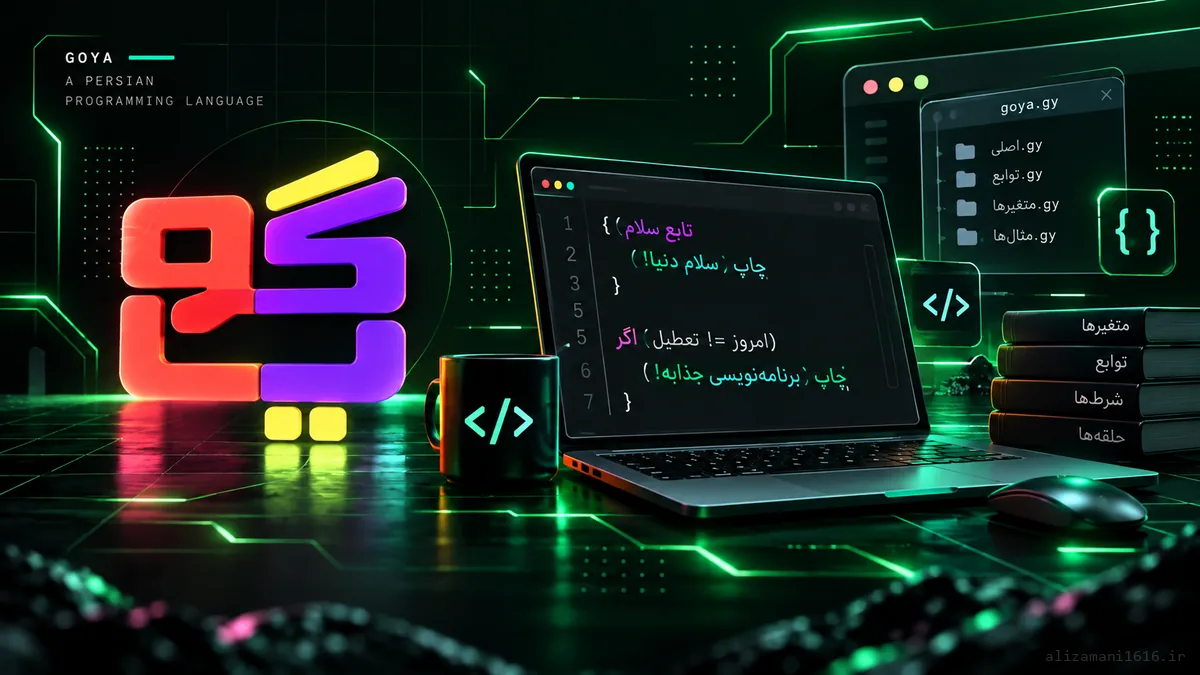
Goya: A Programming Language in Persian
Goya is a Persian programming language whose Persian-ness goes beyond translating a few commands: Persian keywords and digits, Persian error messages, Shamsi (Jalali) calendar support and a right-to-left Persian IDE. This post shows how it works — how to try it in the browser or from the REPL, and where the full MIT-licensed source lives.