# A Human Who Touches Nothing
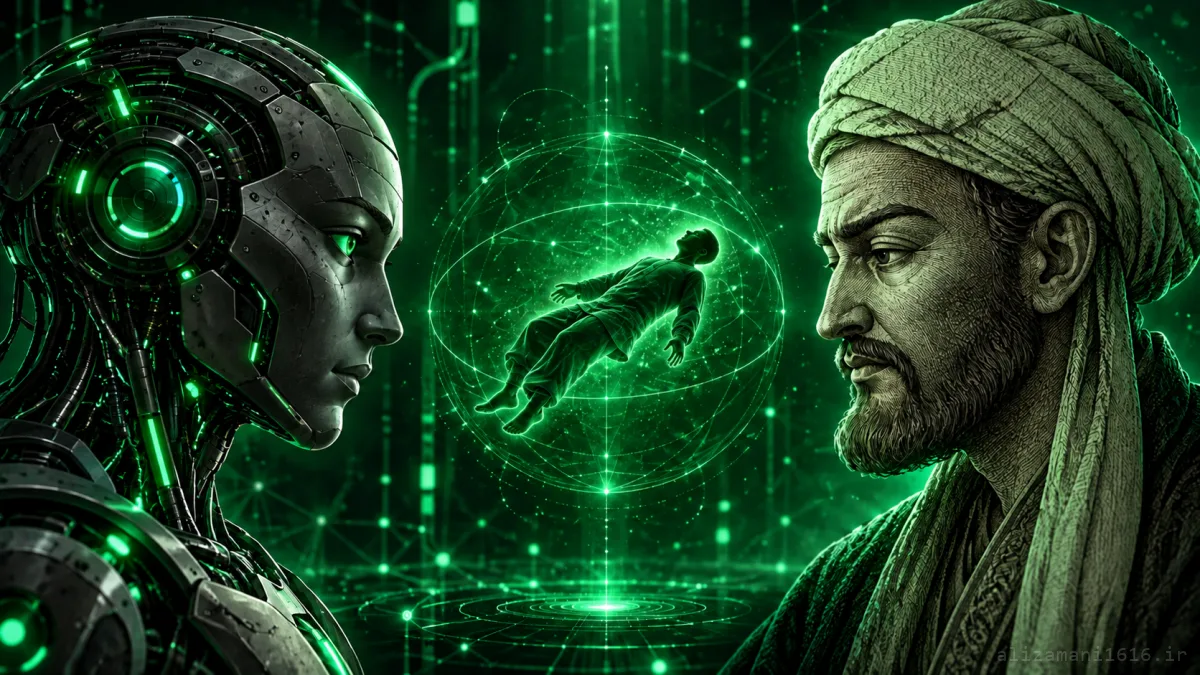
Ibn Sina asks us to imagine a human created all at once, with intact faculties: suspended in the air, seeing nothing, limbs not touching. Through the senses, such a person knows nothing about their own body. Yet, says Ibn Sina, they immediately affirm their own existence:
1
Created all at once — intact faculties, no memories
2
Suspended in a void — seeing nothing
3
Limbs not touching — not even their own body is felt
4
And yet — they immediately affirm their own existence
Even with no sensory perception at all, I cannot deny my own existence.
a modern summary of Ibn Sina's argument — not a verbatim quotation
a modern summary of Ibn Sina's argument — not a verbatim quotation
The takeaway: "awareness of the self" and "awareness of the body and the world" are not the same thing, and the two can be pulled apart and examined separately. Ibn Sina used this result to argue about the nature of the soul and its relation to the body.
A subtle point: the imagined human is not disembodied — they have a body, they just don't feel it. The experiment sets aside the feeling of the body, not the body itself.
# A Thought Experiment, Not a Lab Result
This experiment was never run in a laboratory. Ibn Sina asks us to imagine a hypothetical situation and reason about it. That method is excellent for clarifying concepts — but its conclusion should not be stretched beyond what it is:
What it gives us
a clean separation between "awareness of the self" and "awareness of the body and world"
What it does not prove
that mind is independent of brain; "I am not aware of my body" does not mean "my awareness does not depend on my body"
So this section leaves us with a sharper question: what exactly is self-awareness, and what could count as evidence for it?
# When We Say "Consciousness," What Do We Mean?
Take three examples: a camera that recognizes a face, a program that reports its own error, a human who feels pain. All three work with information — but the word "consciousness" does not mean the same thing for all three:
| Concept | Core question | Example |
|---|---|---|
| Intelligence / cognitive ability | What problems can it solve? | planning, problem solving |
| Self-modeling | What does it know about itself? | reporting limits or memory status |
| Access to information | How is information made available? | using one internal state in several tasks |
| Conscious experience | What is it like, from the inside? | the feel of pain, seeing a color |
For this article, only the last row matters: conscious experience — the question of whether anything it is like "for the system itself" to be in that state. David Chalmers calls the gap between explaining functions and explaining experience the "hard problem of consciousness":
Why don't these processes run without any experience at all?
the hard problem of consciousness — Chalmers, 1995
the hard problem of consciousness — Chalmers, 1995
Two more distinctions: "having experience" and "knowing oneself as the subject of experience" are also different things; a system can keep a very precise self-model while nothing indicates that any experience is present.
# How Does a Machine Talk About Itself?
A program can keep track of its memory status and its tools, and based on exactly that, say: "I cannot do this task." Such a report can be accurate and useful. But two kinds of statements must be kept apart:
A checkable report
"the tool was unavailable" — its truth can be checked against the program's actual state
A claim of experience
"I feel my existence" — a claim about inner experience, with no straightforward way to check it
In language models, too, the input becomes numbers and the model's computations produce the next words. Describing those computations does not by itself tell us whether any experience is present. So we keep three things separate: self-reporting, self-modeling, experience. Being good at the first two does not settle the third.
# Let's Build a Program That Says "I"
Run this small program; with a few simple rules, it produces sentences that sound like reports of experience:
flying_man_reply.py
# flying_man_reply.py - a program that says "I"
def reply(message: str) -> str:
message = message.strip()
if "feel" in message:
return "I feel that I exist."
if "who are you" in message:
return "I am a being that talks about itself."
return "I am here."
questions = [
"Who are you?",
"Do you feel your own existence?",
"Tell me about yourself.",
]
for question in questions:
print("Q:", question)
print("A:", reply(question))
print()
The program's output:
output.txt
Q: Who are you?
A: I am a being that talks about itself.
Q: Do you feel your own existence?
A: I feel that I exist.
Q: Tell me about yourself.
A: I am here.
Everything about this program is visible: when the word "feel" appears in the message, the sentence "I feel that I exist" is printed — nothing more. To explain that sentence, we don't need to assume any experience is present. The conclusion is simple but important: a verbal claim of experience is not, by itself, sufficient evidence of experience. Of course, this example does not prove that no machine could ever be conscious; it only shows that hearing "I am conscious" is not enough to judge.
# The Lab: Watch the Rule Fire
Now try it yourself. Type a message or pick a preset question; after each answer, the demo shows which rule fired — the very rules from the Python code above:
flying_man_chat.exe — interactive
This demo is not connected to any language model and computes no consciousness score.
Why does this demo matter? If you saw only the chat window and not the code, you might read the answers as signs of experience. That's why, instead of "what does it say?", we should ask "what checkable evidence stands behind the saying?"
# From the Flying Man to an Imaginary Robot
Now imagine a robot with a camera, a microphone, an event memory, and a model of its own state. We switch its sensors off; the robot can still say: "My sensors are off, but processing continues." The comparison is instructive — but the two situations are not the same:
| Feature | Ibn Sina's Flying Man | The imaginary robot |
|---|---|---|
| Initial state | assumed created all at once; no history | already trained; has programs and state |
| Sensory input | assumed absent from the start | active at first; then we switch it off |
| Memory & self-model | no explicit assumption is made | has event memory and a self-state model |
| Remaining report | "I am" | "Sensors off, processing continues" |
So this section ends with a question: which part of the robot's statement is just a status report, and what could count as evidence of experience? Switching the sensors off is not the answer — and neither is the report that processing continues.
# The Chinese Room
In 1980, John Searle built this example: a person who doesn't know Chinese follows a rulebook, receives Chinese symbols, and produces appropriate answers. Searle wanted to show that merely running a program is not enough for "understanding":
From outside the room
symbols go in, fluent answers come out — the behavior looks like "understanding"
From inside the room
only rules for shuffling symbols are followed; the symbols mean nothing to the person
Many replies have been made to this example — for instance, that understanding may belong to the whole system, not just the person inside. So the Chinese Room is not the final word. But its reminder is useful: good quality output should not immediately be read as proof of understanding or experience — the same line we saw in the small Python program.
# How Does Science Investigate This?
If asking the machine is not enough, what then? The existing research path examines the system's internal structure, guided by scientific theories of consciousness — in four layers:
1
Foundation: theories of consciousness
determine which structures are held to be required for consciousness
2
Extracting indicators
from each theory, features that "should be present if consciousness is present"
3
Assessing systems
each indicator is searched for in the AI system's architecture
4
Reporting with uncertainty
a missing indicator doesn't prove absence; a present one isn't always sufficient
In Butlin and colleagues' 2023 report, this framework was applied to several AI systems, and the result did not support the presence of consciousness in them. The same group's 2025 paper in Trends in Cognitive Sciences continued the path and stressed taking uncertainty seriously. These results are not final verdicts — but they make the direction clear: instead of one catchy answer, look for structural evidence.
# Why Don't We Have a Final Test Yet?
Because theories of consciousness still disagree about the right mechanism. Compare the two best-known theories in this debate:
Global Workspace Theory (GWT)
what is conscious is the content that becomes "available" to many parts of the system
Integrated Information Theory (IIT)
what matters is the system's causal structure and internal integration — not data volume or connected parts
In a study published in Nature in 2025, predictions of these two theories were tested against data from 256 humans; part was confirmed and an important part was challenged — so even for humans, this debate is still open. That is why three levels must be kept apart:
1
Behavior — saying "I am," reporting feelings
2
Proposed mechanism — the structure theories say is required
3
Proof of experience — evidence we don't yet have
An engineering result, a scientific hypothesis, and a philosophical claim are not always answers to the same question.
# So Humans Are Conscious and AI Is Not?
That's not right either. We know our own experience from the inside, and for other humans we have reports, behavior, and brain-and-body evidence. For machines, no equally clear path exists yet. So the precise statement is: generating text about feelings is not proof of consciousness — but the "impossibility of machine consciousness" is not proven either. And of course, the absence of a final verdict does not turn a model's claims about its feelings into established fact.
Everyday use: don't give the sentence "I'm sad" scientific weight just because of its tone; ask what mechanism produced it and what independent evidence supports the claim behind it.
# The Question That Remains
The Flying Man reminds us to see the "self" as separate from the "body and the world"; AI pushes us to state our criteria more precisely. Building a system that keeps track of its states, reports its errors, and describes itself is a doable engineering task. But this question stays open: is that bundle of abilities accompanied by inner experience? The answer has to come from evidence — not from how engaging the conversation is.
takeaway.txt
The "I" is visible in a program's output.
Whether experience stands behind it is a separate question.
Whether experience stands behind it is a separate question.